
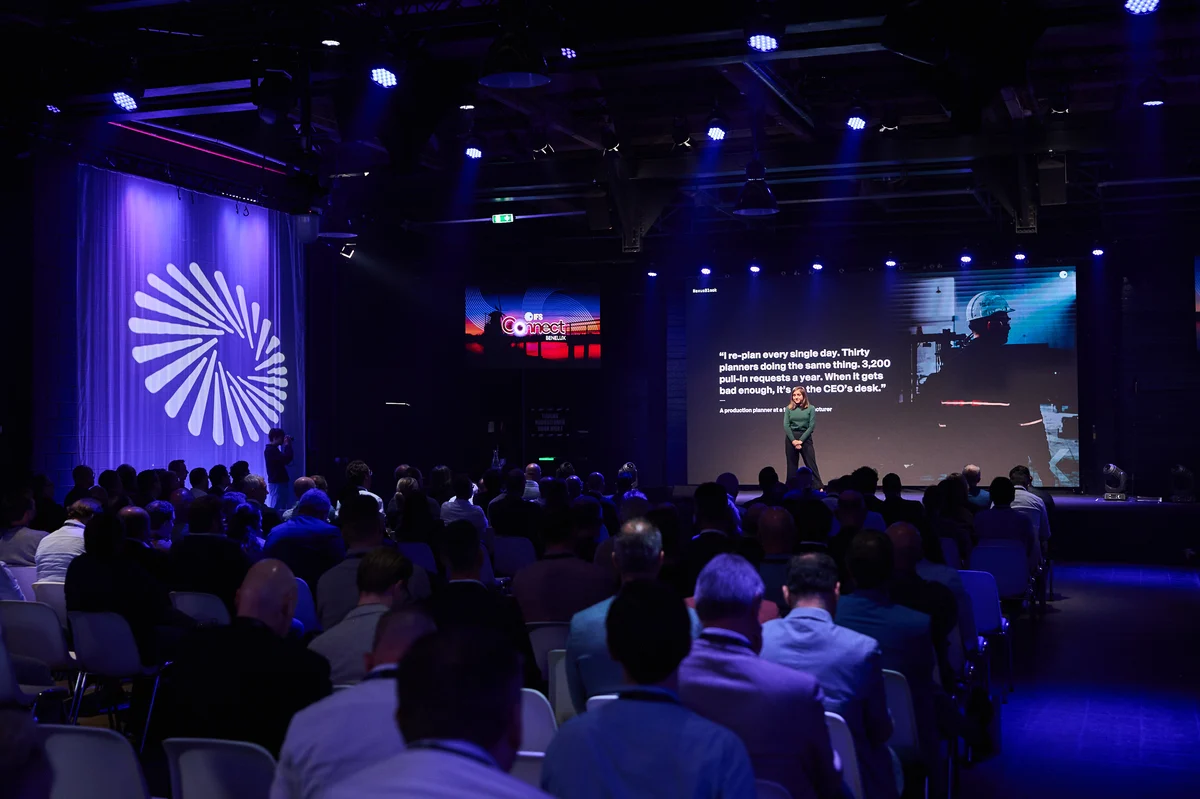
Industrial AI in IFS Cloud has moved from a roadmap conversation to a working demo, and its first value lands in service and asset management. That is our main takeaway from IFS Connect Benelux 2026. The question that brought the sector together there: where does Industrial AI in IFS Cloud stand today, and where is it heading over the next 18 months? The opening keynote kept returning to one point: how companies get measurable AI results on the shop floor faster.
The focus was on asset-intensive and service-driven organisations, where speed, precision and data integration pay off most. Eqeep was there to bring that picture back to our clients. Below we look ahead at what manufacturers and utilities in the Benelux can do with it in the coming months.
Is Industrial AI in IFS Cloud ready for production?
This year it was working live on stage, where a year ago it was still a roadmap conversation. A Boston Dynamics Spot robot walked past an asset setup and flagged a deviation. The robot then autonomously triggered a work order in IFS Cloud, including parts and service level agreement (SLA) priority. It was no concept demo: detection and execution ran in one continuous motion.
IFS and Boston Dynamics announced their collaboration in November 2025, at Industrial X Unleashed in New York. According to that announcement, Spot robots inspect assets and sites, and agentic AI then analyses the data and triggers appropriate actions.
You do not need a robot for a first step. Sensors and IFS Cloud can already turn a reading into a work order with the right parts and technician. Read how IoT and digital twins are changing asset management.
Three building blocks kept coming back. The Industrial AI Accelerator speeds up the rollout of AI use cases. IFS Loops supports data-driven optimisation in a controlled environment. Nexus Black is a reliable foundation for broader digital trajectories.
Together they make the difference between standalone AI experiments and capabilities clients can activate in the domains where they already work with IFS.
IFS launched Nexus Black in April 2025, as a programme for AI problems beyond standard functionality. Customers co-invest and work through four phases, from problem definition to digital continuity.
Where does Industrial AI deliver value first?
In service and asset management. At this edition it quickly became clear that IFS is focusing its first applications there for the near term, rather than on management dashboards. The feedback loop there is short and measurable: less unplanned downtime, faster work orders and better SLA compliance.
The client sessions confirmed that picture, with organisations at different points in their AI trajectory, from first pilots to real efficiency gains. Data quality remains the bottleneck for all of them, and the biggest value right now comes from supply chain optimisation. The question has moved from whether AI works to whether the data underneath is good enough to let it run.
At the same time, the architecture under IFS Cloud is changing. Composable architecture and open APIs turn AI capabilities into modular building blocks. Clients switch on what they need in the domain where the value sits, without large upgrade programmes.
Integrations with existing systems shift from months to weeks. That makes an approach possible that was not feasible before: start on one process and scale what works.
Do not count on those weeks for your own planning. Integration time depends on your systems, data quality, scope and the testing required.
For our clients, 2026 is the year to map what is already in their licence and which building blocks are coming in the next releases. Clients regularly find capabilities they had already paid for.
How do you map what is already in your IFS licence?
Compare the features in your release and licence agreement with what your teams use in practice. Your application manager draws up that overview, which shows the licensed features nobody uses yet.
IFS Cloud has two release updates a year, plus monthly service updates. Which AI capabilities you can use depends on your release and your agreement with IFS. IFS defines a current environment as the latest release or one of its three predecessors. Even a current release can therefore lack capabilities that newer releases include.
Eqeep reviews each release against your processes and advises on relevance and effort. You choose what goes into daily use. To check each release update for features your team does not use yet, read the IFS Cloud features hiding in plain sight.
What can you learn from the IFS Awards 2026 winners?
The IFS Awards 2026 went to Alliander, SPIE Nederland and Dixstone: three Benelux organisations that moved Industrial AI from pilot into their work process. Eqeep runs IFS.ai trajectories with two of the three, so we see up close what these organisations do differently from the rest.
These organisations follow a remarkably consistent pattern. They start small, with one concrete process and a measurable outcome, and avoid a broad AI programme that has to land everywhere at once. Data quality is a project in its own right for them, started before the first model runs. The shop floor gets involved early, so the people who will work with the agent later help set what it may and may not do.

We take the same approach with other clients. We start with one use case with a clear business case, clean up the data underneath and build the governance framework in parallel. We run all three tracks because we have seen what happens when one is missing: the use case stays stuck in pilot.
Why does governance decide whether AI scales?
In every session the same point came back: things go wrong on governance, not on technology. Organisations get stuck on who inside the organisation has the authority to act autonomously on an agent’s recommendation. Without that authority, planning, IT and management step in between each time.
In current IFS.ai trajectories, Eqeep sees the leading organisations arrange this early. They put IT, Operations and Risk at one table and define escalation thresholds per asset class. Before the first agent goes live, they publish an internal decision tree. That preparation lets an autonomous agent keep working instead of waiting for a signature.
Over the next two years, maturity in governance will decide who scales and who stays at pilot level.
Watch the IFS Connect Benelux 2026 highlights
What has changed since IFS Connect Benelux?
On 13 October 2026, during IFS Unleashed in Orlando, IFS brought its Industrial AI together in IFS Intelligence. The decision tree that leading organisations publish before their first agent is still written by your own IT, Operations and Risk teams. In IFS Intelligence, the Industrial AI Harness enforces it through the roles, permissions and approval steps you set in IFS. See what IFS Intelligence does and how Eqeep starts with it.
Questions about IFS Connect Benelux 2026
When and where was IFS Connect Benelux 2026?
On 8 April 2026, at De Rijtuigenloods in Amersfoort. IFS Connect is the series of regional events where IFS brings together customers, partners and its own leadership.
What was demonstrated at IFS Connect Benelux 2026?
Industrial AI in IFS Cloud, working live on stage. A Boston Dynamics Spot robot flagged a deviation at an asset setup. It then autonomously triggered a work order in IFS Cloud, with parts and SLA priority.
Who won the IFS Awards 2026 in the Benelux?
Alliander, SPIE Nederland and Dixstone. All three are Benelux organisations that moved Industrial AI from pilot into their work process.
Where do you stand with Industrial AI in IFS Cloud?
Tell us where you stand with IFS. After one conversation you will have a clear next step. Tell us which decision you want AI to support first. Discuss your IFS question


