
Where does Industrial AI in IFS Cloud stand today, and where is it heading over the next 18 months? That was the question that brought the sector together at IFS Connect Benelux 2026. The opening keynote circled one point: how do companies get measurable AI results on the shop floor faster, not on slides.
The focus was on asset-intensive and service-driven organisations, where speed, precision and data integration pay off most. Eqeep was there to bring that picture back to our clients. Not a vendor update, but a look ahead at what manufacturers and utilities in the Benelux can do with it in the coming months.
From pilot status to production-grade
A year ago, Industrial AI in IFS Cloud was still a roadmap conversation. This year it was working on stage. A Boston Dynamics Spot robot walked past an asset setup, flagged a deviation and autonomously triggered a work order in IFS Cloud, including parts and SLA priority. No concept demo. Detection and execution in one continuous motion.
Under the hood, three building blocks kept coming back: the Industrial AI Accelerator for faster rollout of AI use cases, IFS The Loops for data-driven optimisation in a controlled environment, and Nexus Black as a reliable foundation for broader digital trajectories. That trio matters more than it sounds. It is the difference between standalone AI experiments and capabilities clients can activate on the domains where they already work with IFS.
First value lands in service and asset management
At this edition it quickly became clear where IFS is focusing for the near term. The first applications land in service and asset management, not in management dashboards. The feedback loop there is short and measurable: less unplanned downtime, faster work orders, better SLA compliance. For manufacturers and utilities in the Benelux, the business case pays back in quarters, not years.
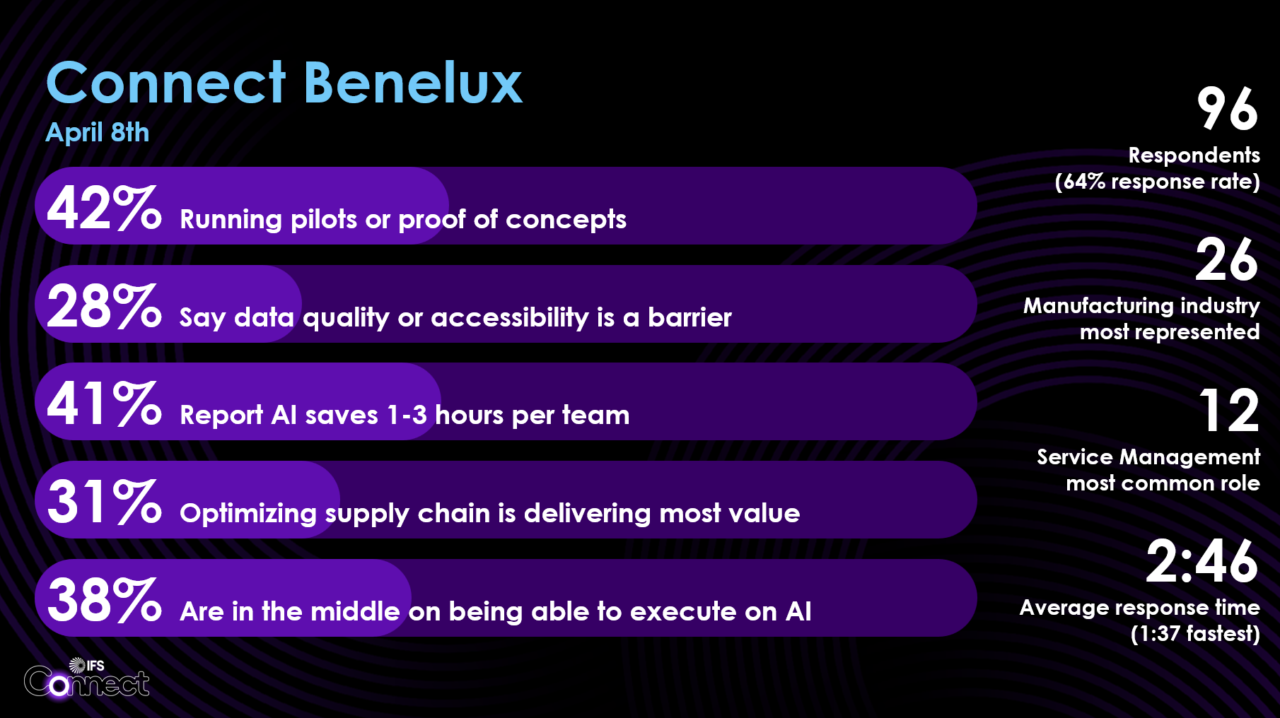
The client sessions confirmed that picture. Organisations sit at different points in their AI trajectory, from first pilots to real efficiency gains. What everyone shares is that data quality remains the bottleneck. And the biggest value right now comes from supply chain optimisation. The question has moved: from whether AI works to whether the data underneath is good enough to let it run.
At the same time the architecture under IFS Cloud is changing. Composable architecture and open APIs turn AI capabilities into modular building blocks. Clients switch on what they need on the domain where the value sits, without large upgrade programmes. Integrations with existing systems shift from months to weeks. That makes an approach possible that was not feasible before: start on one process, scale what works.
For our clients, 2026 is the year to map what is already in their licence and which building blocks are coming in the next releases. Almost every time, a client finds capabilities they had already paid for.
Three winners, and what others can take from them
The IFS Innovation Awards 2026 went to Alliander, SPIE Nederland and Dixstone. Three Benelux organisations that moved Industrial AI from pilot into their work process. Eqeep runs IFS.ai trajectories with two of the three, so we see up close what these organisations do differently from the rest.
The pattern is remarkably consistent. They start small, on one concrete process with a measurable outcome, not on a broad AI programme that has to land everywhere at once. They treat data quality as a project in its own right, before the first model runs. And they involve the shop floor early, so the people who will work with the agent later have helped set what it may and may not do.
That is how we approach it with other clients. We start with one use case where the business case lands within quarters, clean up the data that sits underneath, and build the governance framework in parallel. Not because it is a convenient order, but because we have seen what happens when one of the three tracks is missing: the use case stays stuck in pilot.
Governance decides the outcome, not the algorithm
In every session the same point came back. Technology is not where it goes wrong, governance is. The question organisations get stuck on is not whether the agent makes a good recommendation, but who inside the organisation has the authority to act on it autonomously, without planning, IT and management stepping in between each time.
What Eqeep sees in current IFS.ai trajectories is that the organisations leading here arrange this early. They put IT, Operations and Risk at one table, define escalation thresholds per asset class, and publish an internal decision tree before the first agent goes live. That is not a compliance exercise. It is what lets an autonomous agent keep working instead of waiting for a signature.
Over the next two years, maturity in governance will decide who scales and who stays at pilot level.


 Nederlands